RWS Architecture Vault
RWS Architecture Vault
Welcome to the RWS Architecture Vault - the canonical source of truth for how the RWS platform is designed, how it evolves, and why decisions are made the way they are.
If it's not in the vault, assume it's a rumor.
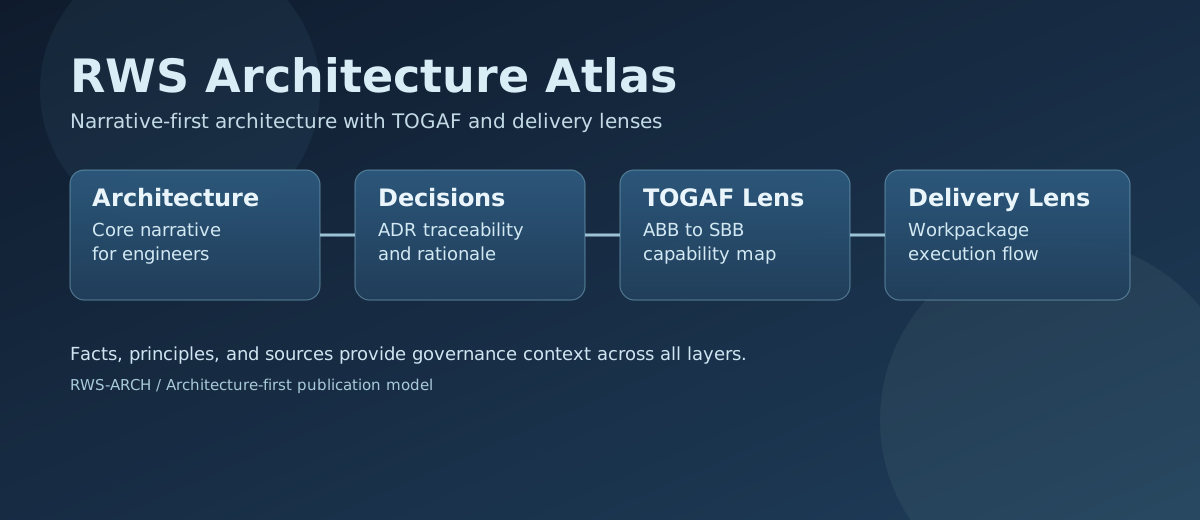
Scope
This landing page is the entry point for architecture, decisions, facts, and sources. Use it to orient yourself, then dive into the domain indexes and supporting notes.
Core Navigation
| View | Purpose | Start Here |
|---|---|---|
| DC 3.0 Project View | Cross-domain DC 3.0 structure, workstreams, and delivery map | DC 3.0 Architecture Structure |
| Architecture (Primary) | Target-state narrative and domain deep dives | Architecture |
| Decisions (ADRs) | Decision rationale, trade-offs, and governance history | Decisions (ADRs) |
| DC 3.0 Building Blocks | Translated ABB/SBB mapping from the lead-architect DC 3.0 model | DC 3.0 Building Block Lens |
| Delivery Planning | Execution scope, sequencing, and implementation flow | Delivery Work Packages |
Vault State Snapshot
| Signal | Current State | Visibility |
|---|---|---|
| Architecture domain coverage | 4 domain landing pages | Architecture |
| ADR coverage | 21 ADR notes | Decisions (ADRs) |
| DC 3.0 ABB layer | 32 translated ABB notes | ABB Catalog View |
| DC 3.0 SBB layer | Candidate implementation notes for mapped ABBs | SBB Catalog View |
| Delivery coverage | 20 workpackages (WP-01..WP-20) | Delivery Work Packages |
Role-Based Entry Rails
| Role | Start | Then | Outcome |
|---|---|---|---|
| Architect | Architecture | Decisions (ADRs) -> DC 3.0 Building Block Lens | Coherent target-state design with explicit rationale and mappings |
| Engineer | Architecture | Delivery Work Packages -> relevant ADRs | Executable implementation path with constraints and dependencies |
| Reviewer / Governance | Decisions (ADRs) | DC 3.0 Building Block Lens -> Architecture | Traceable governance review across design, mapping, and delivery |
Key Concepts
Architecture Domains
Start with the domain landing pages for scoped architecture, diagrams, and related notes. Domain keys and scopes are defined in taxonomy, while TOGAF inventory navigation is maintained in togaf-catalog (physical fabric lives under networking).
- Platform Architecture — platform services, delivery, operating model, and the OpenShift runtime hierarchy.
- DC 3.0 Architecture Structure — project-facing workstream view across architecture, workpackages, and building blocks.
- openshift-concept-overview — OpenShift runtime sub-area baseline under Platform architecture.
- Network Architecture — network services, lane-scoped datacenter fabric architecture (Location A ACI AI-only lane and Location B EVPN/VXLAN target lane), and network-edge (north-south/datacenter edge) load balancing via external ADCs (distinct from in-cluster Kubernetes Service VIP/proxying handled by the OpenShift/Kubernetes networking layer), plus physical fabric constraints where relevant.
- Storage Architecture — backend platform, OpenShift integration, and protection constraints.
- Security Architecture — IAM, policy enforcement, and platform security controls.
- data-science-and-ai — DC 3.0 ABB starting point for AI/ML workloads and inference.
Use taxonomy for canonical domain keys and how they are applied in frontmatter.
Diagram-first entrypoint: Architecture Atlas.
Supporting Views
- DC 3.0 Building Block Lens — ABB/SBB capability-to-solution mapping linked back to architecture and ADR context.
- Delivery Work Packages — implementation packages that trace back to architecture and decisions.
These are secondary lenses: architecture narrative remains the primary source of understanding.
Vault Structure
10-topics/— investigations, knowledge notes, and open questions (including OpenShift runtime topics underplatform/)20-architecture/— stable system and subsystem designs with domain subfolders (platform/,network/,storage/,security/), with OpenShift runtime architecture underplatform/30-decisions/— Architectural Decision Records (ADRs), organized by decision area (platform/,network/,storage/)40-facts/— authoritative, reusable facts and definitions50-sources/— summaries of external inputs that inform the architecture60-principles/— cross-domain guardrails and vision principles; architecture notes should reference applicable principles70-togaf/— DC 3.0 ABB/SBB mapping notes (secondary lens)80-workpackages/— implementation work package notes (secondary lens)
Section landing pages:
- Topics
- Architecture
- Decisions (ADRs)
- Facts and Taxonomy
- Sources and Evidence
- Principles
- DC 3.0 Building Block Lens
- Delivery Work Packages
Note: for topic, architecture, and adr, CI enforces folder/domain alignment; fact and index notes can use other canonical domain keys where explicitly documented (see taxonomy).
Related Decisions (ADRs)
Browse ADRs via Decisions (ADRs) to understand the rationale behind major architectural choices (ADRs are stored under 30-decisions/).
Program Scope
Principles
Supporting Facts
Core reference material lives in 40-facts/; see taxonomy for canonical metadata and way-of-working for note lifecycle rules.
Key Sources
External sources and summaries live under Sources and Evidence (summaries) and assets/vendors (raw vendor files).
Diagrams
Architecture diagrams live under RWS-ARCH/assets/diagrams/ and rendered SVGs under RWS-ARCH/assets/rendered/.
Next Steps
- Read way-of-working before creating or restructuring notes.
- Pick a domain landing page (Platform includes OpenShift runtime, plus Networking, Storage, Security) or browse AI via data-science-and-ai.
- Use DC 3.0 Building Block Lens for capability-to-solution mapping and Delivery Work Packages for implementation scope tracking.
- Contribute in this flow:
00-inbox->10-topics->20-architecture/30-decisions-> optional70-togafand80-workpackageslenses. - Use Obsidian search and backlinks to explore related notes.